
Licence to Occupy vs Lease: What Warehouse Occupiers Need to Know
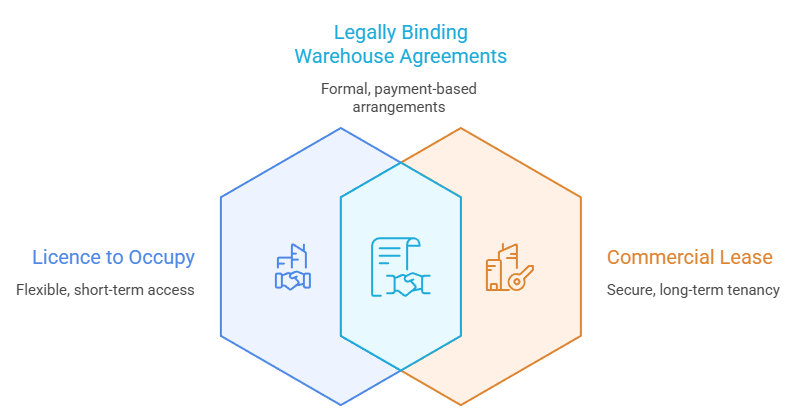
When you start looking for warehouse space, one of the first questions you’ll encounter is whether you’ll be occupying under a licence to occupy or a commercial lease. Both are legally binding agreements between the property owner and the occupier and both require some form of payment, but that’s roughly where the similarities end.
Understanding which arrangement you’re entering into matters far more than businesses realise at the start.
What is a Licence to Occupy?
A licence to occupy is a legal agreement that grants a business permission to use a property for a specific, agreed purpose, without transferring any formal legal interest in the land itself. Think of it as personal permission to be on the property, rather than a right to own them.
This might suit businesses that need temporary storage space while a longer-term unit is being secured or one that wants to use a facility for a short, defined period without committing to a full lease.
What is a Commercial Lease?
A commercial lease is a formal legal contract that grants the tenant exclusive ownership of a property for a fixed term. This means that you occupy the space to the exclusion of everyone else (including the landlord) and you hold a legal interest in the land for the length of the agreement.
Leases are typically used for longer-term occupation and carry greater rights and protections, including those set out in the Landlord and Tenant Act 1954.
Find Warehouse Space
The Biggest Differences
Exclusive Possession
Under a lease, the space is legally your own for the term agreed upon. Whereas, under a licence, the landlord keeps the right to access the property and you do not exclusively own the space.
Security of Tenure
A commercial lease (unless the parties have formally contracted out of it) gives you security of tenure under the Landlord and Tenant Act 1954. This means the landlord cannot simply remove you at the end of the term without valid statutory grounds. A licence provides no such protection; the licensor can end it with reasonable notice.
Length and Flexibility
Leases are typically used for longer periods and tie both parties into fixed terms. Licences are shorter, more flexible and can be terminated more quickly by either side.
Assignability
A lease can, in certain circumstances, be assigned to another party. A licence is personal, it cannot be assigned and ends if the licensor sells or disposes of the property.
Which is Right for Your Warehouse Needs?
If you need a warehouse for a short period, a licence to occupy can be a practical, low-commitment solution. It’s quicker to set up and involves less legal complexity.
If you’re planning to use a unit as a long-term operational base, invest in racking or fitout or simply just need the certainty that you won’t be removed at short notice, a commercial lease gives you the protection and stability to plan ahead with confidence.

Here at Warehouse Space, we help businesses to find the right space for their needs. Whether you’re looking for a flexible short-term arrangement or a committed lease, we’ll match you with the right option, just get in touch with our team today.